Wednesday, August 11, 2010

Day 7: On to Bergen

Leaving Ullensvang on Day 7, the group took a 10-minute ferry across Hardangerfjord and began the steady climb to Voss. A mixture of rain and sun, but the sky was beginning to clear, bringing the promise of good weather for the "Norway in a Nutshell" tour. A brief stop in Voss saw most travelers enjoy a visit to the stone church which dates from 1277. Nearby a plaque honoring Voss' native son Knute Rockne (nee: Knut Rokne) who is best known as the Notre Dame University football coach in the 1920s.


At Gudvangen, we began a 2-hour fjord cruise of two narrow and incredibly spectacular arms of the majestic Sognefjord that would take us to Flåm. En route, we passed several old restored steam ships (see photo) that had previously served as the main transportation on the fjord in decades past. The Nærøyfjord and Aurlandfjord welcomed us as the clouds disappeared and the tourists hugged the rails for a better view.


In Flåm, we enjoyed a quick lunch before boarding the 60-minute journey up the valley, through 20 tunnels and the most breath-taking views one might imagine. At the end station, Myrdal, we transferred to the local train for the ride back to Voss where our purple bus awaited to drive us in to Bergen.


Cruising the Sognefjord. Pictured above: Celine Osborn (left); Bertie Perry (right); Sally Ann Sample and Bruce Nelson (center)

Tuesday, August 10, 2010

Day 6: Around Hardangerfjord

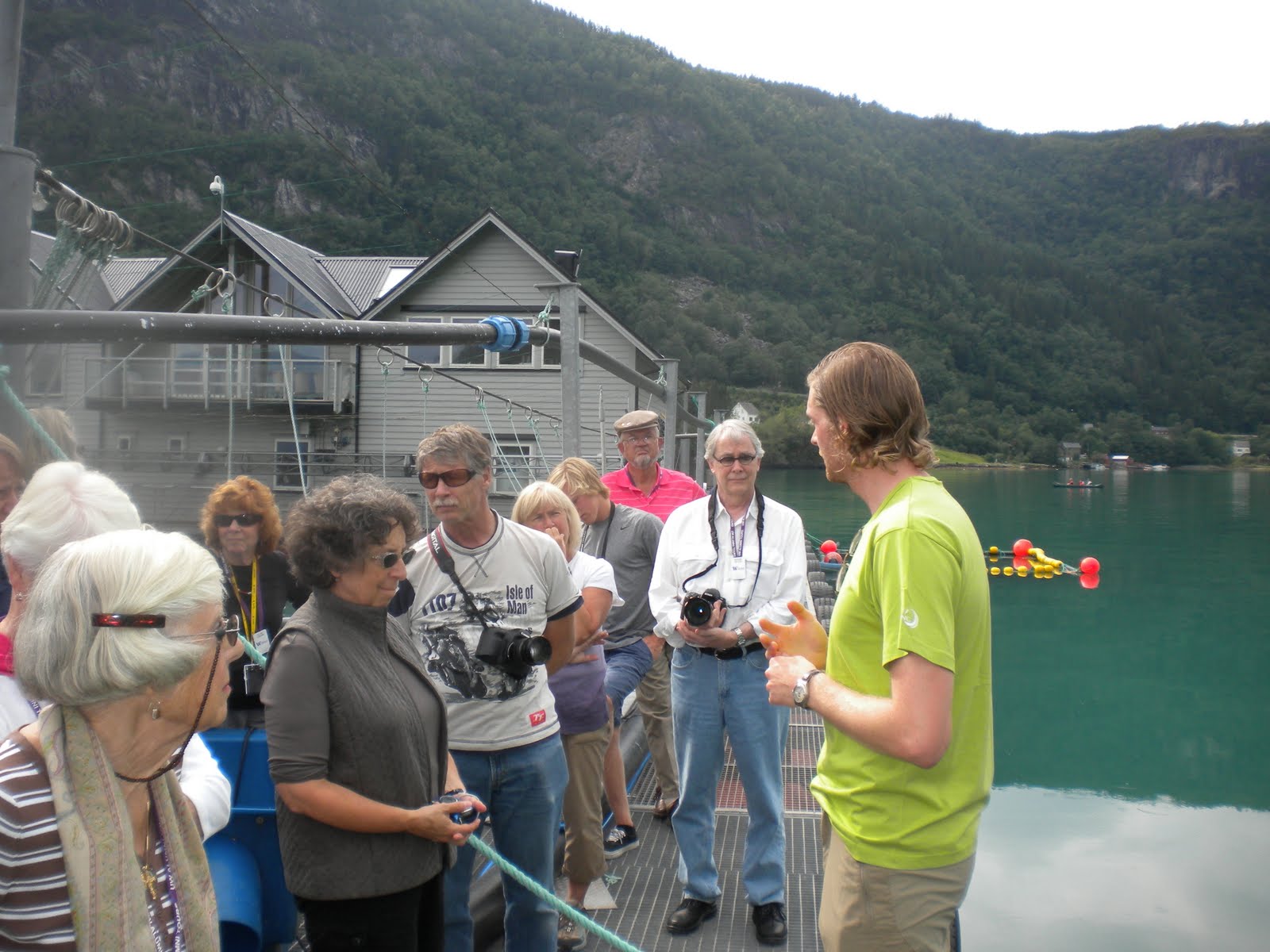
A visit to an industrial center, a floating fish farm and a fruit farm were the focus of the agenda that took the tour participants around Hardangerfjord on Day 6.


The municipality of Odda lies at the end of Sørfjord, an arm of the Hardangerfjord. Best known formerly for its industrial smelters producing carbide and cyanamide and depending on powerful power stations to fire the arc furnaces, today, while there is still some industrial production, strong environmental regulations are in place to eliminate the pollution.


Formerly a disagreeable site for Norwegian heavy industrial pollution, Odda today presents visitors with spectacular views of Fjord-Norway.

Odda harbor (left); Sculpture of Smelter workers (right)


From Odda and heavy industry, the tour moved on to visit the Hardanger Aquasenter Salmon Farm and the Steinstø Fruit Farm. Two small family businesses, they typify how Norway has developed special niche areas that can be world class.


A fascinating day that provided interesting insight and a representative overview of daily life and work in rural west Norway.


A plum tree with its fruit (above);
an orientation at the Hardanger Aquasenter (left); Tour participant, William Burlingame enjoying a break (right)

Monday, August 9, 2010

Day 5: Bus to Hardanger - and a purple one at that

Day 5 brought a bus ride from Oslo to Lofthus in Hardanger. Heading west and northwest, the trip followed the Halling valley from Hønefoss to Geilo, on across the Hardanger plateau with spectacular views of the Hardanger glacier, a stop at Vøringsfossen (the Vøring waterfall) before descending to the Hardanger fjord and on to Lofthus and Ullensvang Hotel. A full day that, upon reflection at dinner, caused several travelers to wonder if yesterday's events had not taken place two or three days earlier rather than a mere 24 hours. Norway's spectacular scenery served as a 3-D motion picture outside the bus windows. Stops at Gol and on the middle of the Hardanger plateau itself, brought a fury of picture-taking by all. Arriving at the majestic Ullensvang Hotel, facing the beautiful Sørfjjord arm of the Hardanger fjord and surrounded by apple and cherry trees that climb the hillside from sea to sky, a mixture of relief and anticipation gripped the hungry travelers as they headed for the spacious dining room.

Day 4: Another Palace and Overnight to Norway

Day 4 began with a visit to Christiansborg Palace, then on to view the changing of the royal guard at the Amelienborg palace before heading for the DFDS overnight cruise/ferry to Oslo. No pictures allowed in Christiansborg palace, but its size and splendor rival both the Tsar's Winter Palace in St. Petersburg, minus the artwork, and the Hohenzolleren palaces in Potsdam. And, of course, the ubiquitous Christian IV, meets visitors astride his horse.


At Amelienborg Palace, the four-palace complex of the Royal Family, a light rain may have kept down the crowds, but hardly dampened the pagentry of the changing of the guard. Young men, not much more than 19-20 years old dressed up like one of H.C. Andersen's Tin Soldiers, marched through the square performing their daily ritual to the delight of the assembled crowd.


As late aftenoon approached, it was time to head for the harbor and the overnight ferry to Oslo. Sailing at 5 pm from "Copenhagen, the DFDS ferry is, in reality, a cruise ship, tax free shops, restaurants and a hotel. Sailing through the night, we passed the Norwegian fortress island of Oscarsborg at 8 am, just prior to the scheduled 9:30 arrival in Oslo. On April 9, 1940, the German troop ship Blucher was sailing toward Oslo with the specified mission of capturing the Norwegian government and the royal family as German forces invaded and occupied the country. Facing the approaching ship when it refused to identify itself, the defending Norwegian forces opened fire, hitting the magazine and causing a horrific explosion. The Blucher sank, over 2000 German soldiers were killed and the Norwegian government and king had time to excape capture. As we passed the fortress this morning, we also noted that small oil slicks lay on the water above where the Blucher came to rest that fateful day in WWII. We docked near the new Oslo Opera House, disembarked and began our drive west.

Saturday, August 7, 2010

Day 3: Dragør and Rosenborg Palace

Scandinavian Odyssey: Day 2 in Copenhagen included a visit to the historic seaside village of Dragør and the Rosenborg Palace.

Dragør...

Located on the south-east coast of the little island of Amager, Dragør is a mere 12 kilometers from downtown Copenhagen. The little fishing village of Dragør was established in the 12th century and prospered when the Hanseatic League was given special fishing and trading privileges in 1370. In 1521, King Christian II invited Dutch farmers to settle on Amager and produce food for the Royal Household. They brought new agricultural techniques to Denmark and, among other things, introduced the carrot to the country. In October, 1943, Dragør played an important role in the successful escape of Danish Jews as fishing boats from the village were used to secretly transport them out of the clutches of the Gestapo and across the Øresund to neutral Sweden. One such boat, the Elizabeth K571 (pictured below), can be seen today in the harbor at Dragør. A memorial nearby commemorates the dramatic events on the night of October 1-2, 1943.


Following a short drive back to the center of Copenhagen, the group visited Rosenborg Palace, built as a summer house by King Christian IV in 1606-07. Situated in Kongens Have (the King's Garden), the Dutch Renaissance building today houses the Danish crown jewels, a beautiful tapestry collection, portraits and personal objects of the king and royal family from the 16th to the 19th centuries. The Great Hall with the absolutist throne carved out of ivory is guarded by three silver lions. In the basement, guarded but accessible to the public are the crown jewels, dominated by the golden, bejeweled crown of the absolute monarchy from 1660 to 1849.

Pictured above are the Rosenborg Palace (right), the Ivory Throne (left) and the Absolutist Crown (center)


Friday, August 6, 2010

Days 1-2: UW Alumni Tour Kicks Off Scandinavian Odyssey in Copenhagen with a Visit to Tivoli


Catching up with the body clock and fighting jet lag, the 2010 Scandinavian Odyssey travelers began their adventure in Copenhagen with a walking tour of Tivoli Gardens and a wonderful dinner in one of the park's elegant restaurants. More than the usual tourist spots, however, while the Little Mermaid is being exhibited at the Shanghai World's Fair, it is worth taking note that Copenhagen has emerged as one of the most eco-conscious and creative cities in the world. Danes still love their Carlsberg and their pastries, but almost 1/4 of all food served in Copenhagen is organic. Bicycles rule the road (and sometimes the sidewalk) and green power is the wave (tsumami?) of the future.


Established by Georg Carstensen in 1843, Tivoli served as the model of Walt Disney's imaginative re-creation called Disneyland in the 1950s. Getting to know each other, the travelers are ready for an exciting two-week adventure in Denmark, Norway and Sweden.


Enjoying their visit to Tivoli as a family are Alumni Tour participants: Conner, Karl, Kristin and Sharon Nelson

Monday, May 31, 2010

Scandinavian Odyssey


Scandinavian Odyssey is a tour of Denmark, Norway and Sweden, sponsored by UW Alumni Tours, August 5-21. Look for photos and updates on the tour beginning in the second week of August. Check out the UW Tours web site for info on the tour here.