Wednesday, August 18, 2010

Day 14: From Norway to Sweden

An early departure from Oslo with the promise of rain for most of the day. We have been pretty lucky so far, however, getting rain when we travel and sun when we stop. That's a pattern that is hard to beat. From Oslo, the drive took us north to Hamar, then east through Elverum, Midtskogen, and Trysil, then crossing into Sweden to the Dalarna region, passing through Sälen, Mora, and Rättvik before stopping at the Hotel Dalecarlia in Tällberg on the shores of Lake Siljan.

At Elverum, we were reminded of the fateful days of 9-10 April, 1940, when invading German forces tried to capture, then kill the Norwegian royal family, the government and the members of Parliament (Storting). At Elverum, the Storting members voted to authorize a government in exile should that become necessary, and at Midtskogen, a fierce battle delayed German progress sufficiently to allow the escape of the Norwegian royal family, government and Storting members.


Memorial stone at Midtskogen, commemorating the battle on April 9, 1940, delaying German forces as they moved to occupy the country and attempted to capture the Norwegian Royal Family.


Crossing the border into Sweden was barely noticeable. The street signs changed color and the houses seemed all to be painted red, but otherwise not much to mark that we had left Norway. Passing Sälen, we noticed the long open area where the famous Vasalöppet ski race begins every winter. The race traces a ski route of Gustav Vasa in reverse when he led the Swedes in their war of independence against Denmark and the Kalmar Union in the early 16th century. The race ends at Mora after 85 km and some four hours after it begins. In Mora, we exchanged some money and noted the huge local church proudly proclaiming that the tower had been added by King Carl XI in 1673. Seems like only yesterday.


Waiting out the rain are (left to right) Richard and Sally Wilson, Charles Osborn and Walt Reissig


From Mora, we headed for one of those places that seem both comical and charming. Nusnäs is a little village with a small factory producing one of Sweden's iconic images, the Dala horse. With the timing of a stand-up comedian, the pleasant horse-carver told of the work in the little factory. Sixty carvers in the region supply thousands of little wooden horses that are painted red, blue, black, gray or neutral, then decorated and shipped all over the world. A three meter high horse currently exhibited at the Shanghai World Exposition threatens the little factory with the possibility of unlimited orders from China. Think of the potential, our carver noted wryly.


The Dalarna horses in the Nils Olsson Hemslöjd in Nusnäs await final touches and shipping to eager customers.


Arrival and check-in at the Hotel Dalecarlia brings an end to a fascinating day.


Looking out over Lake Siljan from the Hotel Dalecarlia


------------------------------------------------------------------------------

Tuesday, August 17, 2010

Day 13: Oslo - a tourist's view

Staying in the middle of Oslo at the Grand Hotel, the group is witness to a busy street life outside the front doors. Directly across Karl Johan street is the Storting, Norway's national parliament. The main train station is a 15-minute walk away, while the Royal Palace (Slottet) is about 5 minutes from the hotel entrance. Restaurants, museums, and several major galleries, are within a 5-10 minute walk. Oslo is a small big city.


Fountains and reflecting pool in Studenterlunden, across the street directly in front of the hotel

A park with reflecting pool, fountains, statues and a lively mix of people speaking a babel of languages runs alongside Karl Johan Street from the Parliament buildings to the National Theater.


--------------------------------------------------------------------
William Burlingame in front of Vigeland's iconic monolith, "Struggle for Survival."


A visit to Frogner Park to view the bronze and granite statues of Gustav Vigeland was followed by a drive out to Bygdøy to see the Viking Ship Museum and the three 9th century Viking ships (Tune, Oseberg and Gokstad). The Oseberg, with its ornately carved prow and stern, was most likely a ceremonial ship with its somewhat shoddy construction but richly furnished as a burial ship for two women. The Gokstad ship, on the other hand, is a sleek, symmetrically built war ship buried with a single male, probably a chieftan.


The Oseberg ship (left) had two women buried on it along with farm animals, tools, household items and food. All that might be necessary in the next life.


The sleek Gokstad ship was most likely a war ship with its sleek lines and streamlined construction. It served as the burial tomb of a 60-year old male chieftan around the middle of the 9th century.


-----------------------------------------------------------

From the Viking ship museum, the group visited the Norwegian Folk Museum with its late 12th century stave church "kidnapped" from Gol, Norway, by King Oscar II in the late 19th century, then placed in the middle of Oslo as an homage to the country's national romantic culture and rural past. Built around 1200, the Gol Stave Church is one of approximately 25 left in Norway that date back to the early Christian period of the 12th and 13th centuries. Next to the stave charch was an eighteenth century farm house, furnished with the finest goods available in Norway around 1738.


In front of the Gol Stave Church


Eighteenth century painting (ca. 1718) of a Norwegian farmer in the field with his rake, axe, scythe and shovel. Painting hangs in the early 18th century house in the Oslo Folk Museum.


---------------------------------------------------------------------

Monday, August 16, 2010

Day 12: Gudbrandsdalen & Lunch in Lillehammer

Monday, August 16 proved to be a quick day that carried us from the Wadahl Mountain Hotel at Gålå to Oslo by way of the Gudbrandsdalen with a stop in Lillehammer for lunch and a visit to the Olympic ski center.


(Left to right: Bertie Perry, Gloria Henning, Sally Wilson and "Polly" Ellingson at the 1994 Winter Olympic site overlooking Lillehammer.)


After watching intrepid ski jumpers doing some summer practice jumps on the rubber slopes, our small group of Alumni travelers sauntered down the main pedestrian street of Lillehamer, Storgaten, while some hiked up the hill to visit Maihaugen, the original open air Folk Museum in Norway.


I found a small, nearly out-of-the-way restaurant for lunch -- Nikkers. A funky little place on a sidestreet with an outside deck hanging over a gushing mountain stream tumbling its way to eventually join Lake Mjøsa.

At four o'clock in the afternoon, the purple bus had come full circle in 8 days. Two nights in Oslo await the group before they set out for the final leg of their Scandinavian Odyssey - touring rural and urban Sweden, Dalarna and Stockholm.


The Grand Hotel on Karl Johansgate.


--------------------------------------------------------------------

Sunday, August 15, 2010

Day 11: Geiranger to Gudbrandsdalen

Drawing of Geiranger fjord by Ellen Wineberg (8/15/2010)

Leaving Hotel Union didn't mean leaving Geiranger, at least not until the climb up the mountain to Strynefjellet was behind us. Naturally, we did all we could to catch those last glimpses of the valley and the fjord below. Stopping at several viewpoints, we emerged above the valley's clouds and looked down and across to the Jostedal glacier itself. "Vestland, Vestland, når eg ser deg slik,..."


Celine and Charles Osborn (above left);
Constance "Polly" Ellingson and Roger Cohen (above right)


Kurt Pedersen is the bus drive for the group. Here he is pictured with Carina, his "Significant Other" (Samboer) at Dalnibba, at the very top of the valley from Geiranger. From Dalnibba, we drove to Lom, then on to Wadahl Høgfjellshotell, near Gålå, north of Lillehammer. This is Peer Gynt country, rich with the folklore that inspired Henrik Ibsen to invent his most endearing fictional character.


Arvid Iversen serves as Odyssey's highly competent and friendly tour director for the group. With a keen eye and insightful knowledge of Scandinavia, he is able to add information and color that enriches the experience of traveling in Denmark, Norway and Sweden.


--------------------------------------------------------------------


Saturday, August 14, 2010

Day 10: Geiranger

A leisurely breakfast at the Hotel Union before beginning the day's excursion. Another delightfully warm and sunny day in "Fjord Norway."
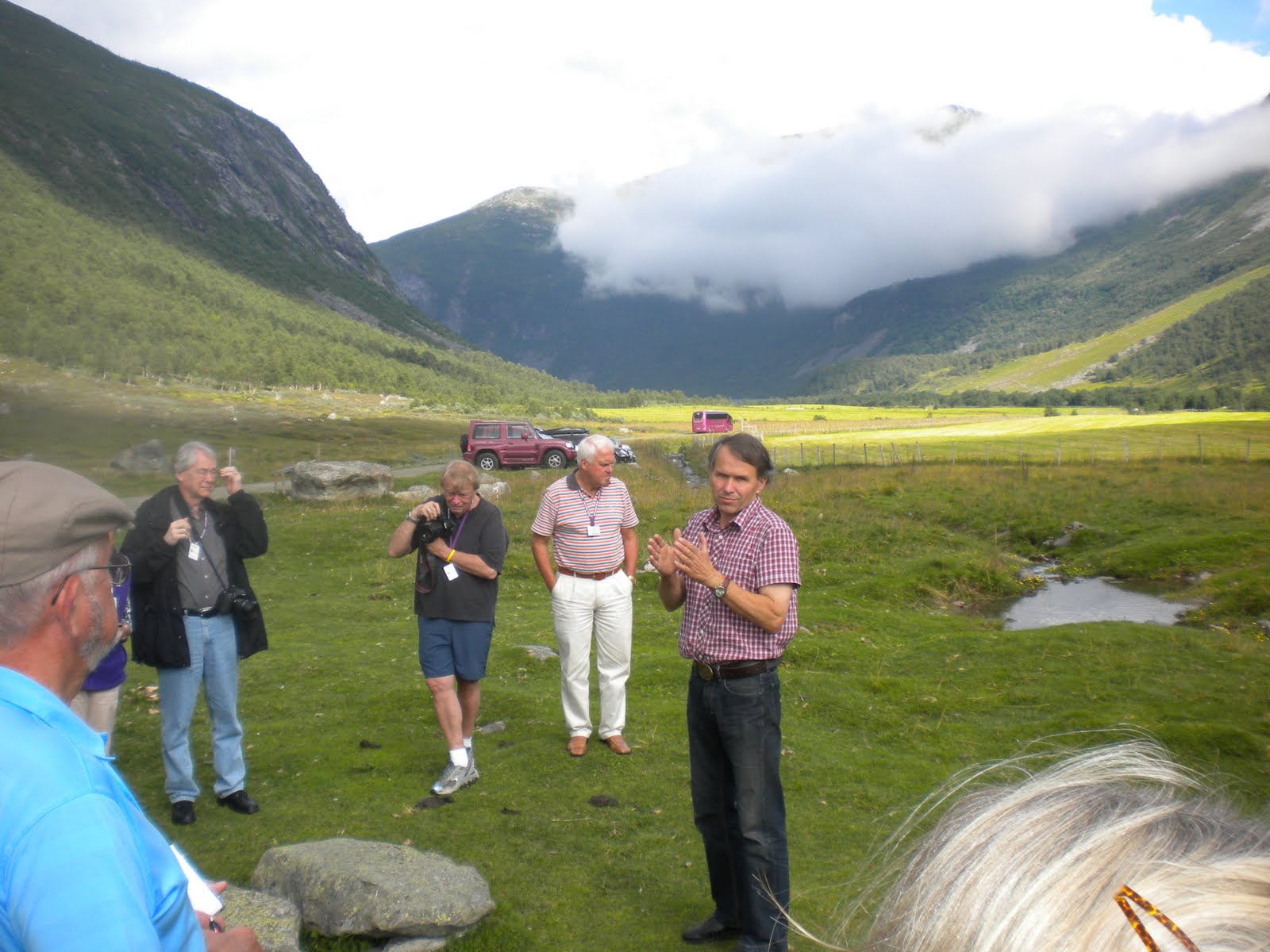
Up the "Eagle's Road" to a majestic lookout over the Geiranger fjord. Before heading inland to Herdalssetra near Norddal on the Storfjord, we stopped for a group photo. Geiranger fjord is on the UNESCO list of World Heritage sites, and it's easy to understand why this place is something special.


Sally and Richard Wilson (above left)
Kenet Frodl (above right)
Walt and Kay Reissig (below)


-----------------------------------------------

At Herdalssetra farm where cheese of many sorts are made in the old fashioned way - by hand. Run by Åshild and Jostein Dale, the farm produces milk and cheese products for the Tine cooperative dairy group as well as for personal use. Actively adhering to standards of sustainable agriculture, the farm and mountain saeter in the valley are part of the larger organization to support and maintain traditional agricultural in Norway. A Norwegian website, Norsk Seterkultur has been developed as part of the initiative.


-------------------------------------------------

Back in Geiranger, the Hurtigruten ship, Nordlys, had sailed into the fjord. In the summer months, each of the Hurtigruten ships make a visit to Geiranger as they ply the coast with tourists, food and equipment for the many coastal villages that dot the Norwegian coastline between Bergen and Kirkenes.


Friday, August 13, 2010

Day 9: A Brief Stop at Hellesylt


A small village on a small arm of the Storfjord ("Great Fjord"), Hellesylt is the jumping-off place if one takes the scheduled ferry to Geiranger. On the road between Stryn and Stranda, this is most often a place people are coming to or going from. That is life when you are a cross-road.


Thursday, August 12, 2010

Day 9: Bergen to Geiranger

The purple bus left Bergen early this morning driving north. Sognefjord and Nordfjord were the main areas for the tour today. A gray, overcast sky kept temperatures down, but the clouds were high enough that they did not hinder the views that are so typical of western Norway. A quick rest stop after crossing the Sognefjord allowed a glimpse back over Norway's longest fjord.


Stops at Førde and Stryn gave the opportunity for a quick visit and a brief walk around a small western Norwegian town. Both serve as administrative centers for the surrounding countryside. Small, but functional shopping centers offered residents and visitors alike a broad commercial array of food, clothes, coffee, and souvenirs. Before reaching Geiranger, the scenery seemed to get more and more spectacular as though building toward a crescendo of sights and sounds.

(View of Nordfjord from Utvikfjellet)


(Public art disguised as a fountain in Stryn)


At Hellesylt, the ferry awaited to take us to Geiranger. Being late in the summer, the waterfalls were far from their most impressive. Of the Seven Sisters, for example, only three of them seemed to be home at all. A waterfall across the fjord from the Seven Sisters, he "Suitor," on the other hand, was undaunted and brought as much water as ever to the fjord.


Hellesyltfoss and Hellesylt Bro (Hellesylt Bridge) on the way to the ferry landing.


The Seven Sisters waterfall. Not quite as impressive as they can be when there is ample water supply in the lake above. Here, it is as though several of the sisters hadn't returned from summer vacation yet.


Passing a sister ferry on the way from Hellesylt to Geiranger