Friday, August 13, 2010

Day 9: A Brief Stop at Hellesylt


A small village on a small arm of the Storfjord ("Great Fjord"), Hellesylt is the jumping-off place if one takes the scheduled ferry to Geiranger. On the road between Stryn and Stranda, this is most often a place people are coming to or going from. That is life when you are a cross-road.


Thursday, August 12, 2010

Day 9: Bergen to Geiranger

The purple bus left Bergen early this morning driving north. Sognefjord and Nordfjord were the main areas for the tour today. A gray, overcast sky kept temperatures down, but the clouds were high enough that they did not hinder the views that are so typical of western Norway. A quick rest stop after crossing the Sognefjord allowed a glimpse back over Norway's longest fjord.


Stops at Førde and Stryn gave the opportunity for a quick visit and a brief walk around a small western Norwegian town. Both serve as administrative centers for the surrounding countryside. Small, but functional shopping centers offered residents and visitors alike a broad commercial array of food, clothes, coffee, and souvenirs. Before reaching Geiranger, the scenery seemed to get more and more spectacular as though building toward a crescendo of sights and sounds.

(View of Nordfjord from Utvikfjellet)


(Public art disguised as a fountain in Stryn)


At Hellesylt, the ferry awaited to take us to Geiranger. Being late in the summer, the waterfalls were far from their most impressive. Of the Seven Sisters, for example, only three of them seemed to be home at all. A waterfall across the fjord from the Seven Sisters, he "Suitor," on the other hand, was undaunted and brought as much water as ever to the fjord.


Hellesyltfoss and Hellesylt Bro (Hellesylt Bridge) on the way to the ferry landing.


The Seven Sisters waterfall. Not quite as impressive as they can be when there is ample water supply in the lake above. Here, it is as though several of the sisters hadn't returned from summer vacation yet.


Passing a sister ferry on the way from Hellesylt to Geiranger

Day 8: Bergen and Grieg

Sunshine in Bergen is like putting butter on bacon - superfluous. Not a voice was raised in protest, however, as a sun-splashed day greeted the visitors to the city that has an umbrella as its most endearing symbol. A tour of Troldhaugen, the home of Edvard and Nina Grieg in the final decades of his life, served as the appetizer and the entre to the delights of the day. Preserved and displayed as when the Griegs still lived in it, the home gives added soul to the music of Norway's national romantic composer. Following the Grieg home tour and a sightseeing excursion up and down the Bergen mountainsides, the Alumni travelers headed in different directions to spend the day exploring on their own. It was a day that proved to have its own reward.


If you see Ellen Wineberg seated on a bus or on a bench, chances are she is drawing sketches in an artist's notebook. A renowned artist based in Massachusetts, Ellen seemed to enjoy comparing notes with Edvard Grieg in his lifesize pose on the grounds of the Grieg home. (See Ellen's webpage here.)


Frequent UW Tour travelers, Gloria Hennings (left) and Bertie Perry (right) enjoyed the visit to Troldhaugen.


In spite of a growth spurt that left the 4'11" Edvard Grieg well behind him in height, Bruce Larson comforted the composer with a warm hug and a smile.

Wednesday, August 11, 2010

Day 7: On to Bergen

Leaving Ullensvang on Day 7, the group took a 10-minute ferry across Hardangerfjord and began the steady climb to Voss. A mixture of rain and sun, but the sky was beginning to clear, bringing the promise of good weather for the "Norway in a Nutshell" tour. A brief stop in Voss saw most travelers enjoy a visit to the stone church which dates from 1277. Nearby a plaque honoring Voss' native son Knute Rockne (nee: Knut Rokne) who is best known as the Notre Dame University football coach in the 1920s.


At Gudvangen, we began a 2-hour fjord cruise of two narrow and incredibly spectacular arms of the majestic Sognefjord that would take us to Flåm. En route, we passed several old restored steam ships (see photo) that had previously served as the main transportation on the fjord in decades past. The Nærøyfjord and Aurlandfjord welcomed us as the clouds disappeared and the tourists hugged the rails for a better view.


In Flåm, we enjoyed a quick lunch before boarding the 60-minute journey up the valley, through 20 tunnels and the most breath-taking views one might imagine. At the end station, Myrdal, we transferred to the local train for the ride back to Voss where our purple bus awaited to drive us in to Bergen.


Cruising the Sognefjord. Pictured above: Celine Osborn (left); Bertie Perry (right); Sally Ann Sample and Bruce Nelson (center)

Tuesday, August 10, 2010

Day 6: Around Hardangerfjord

A visit to an industrial center, a floating fish farm and a fruit farm were the focus of the agenda that took the tour participants around Hardangerfjord on Day 6.


The municipality of Odda lies at the end of Sørfjord, an arm of the Hardangerfjord. Best known formerly for its industrial smelters producing carbide and cyanamide and depending on powerful power stations to fire the arc furnaces, today, while there is still some industrial production, strong environmental regulations are in place to eliminate the pollution.


Formerly a disagreeable site for Norwegian heavy industrial pollution, Odda today presents visitors with spectacular views of Fjord-Norway.

Odda harbor (left); Sculpture of Smelter workers (right)


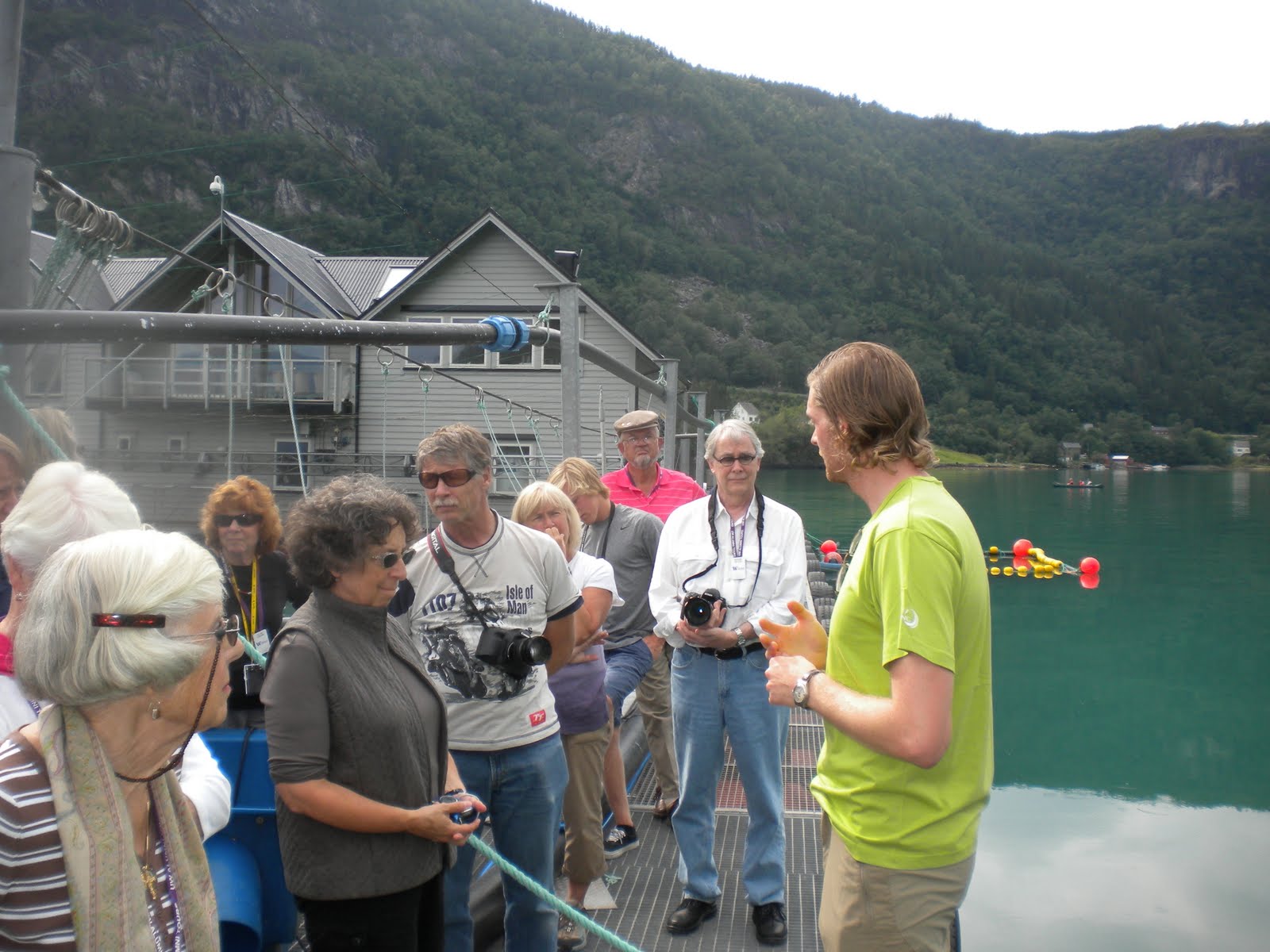
From Odda and heavy industry, the tour moved on to visit the Hardanger Aquasenter Salmon Farm and the Steinstø Fruit Farm. Two small family businesses, they typify how Norway has developed special niche areas that can be world class.


A fascinating day that provided interesting insight and a representative overview of daily life and work in rural west Norway.


A plum tree with its fruit (above);
an orientation at the Hardanger Aquasenter (left); Tour participant, William Burlingame enjoying a break (right)

Monday, August 9, 2010

Day 5: Bus to Hardanger - and a purple one at that

Day 5 brought a bus ride from Oslo to Lofthus in Hardanger. Heading west and northwest, the trip followed the Halling valley from Hønefoss to Geilo, on across the Hardanger plateau with spectacular views of the Hardanger glacier, a stop at Vøringsfossen (the Vøring waterfall) before descending to the Hardanger fjord and on to Lofthus and Ullensvang Hotel. A full day that, upon reflection at dinner, caused several travelers to wonder if yesterday's events had not taken place two or three days earlier rather than a mere 24 hours. Norway's spectacular scenery served as a 3-D motion picture outside the bus windows. Stops at Gol and on the middle of the Hardanger plateau itself, brought a fury of picture-taking by all. Arriving at the majestic Ullensvang Hotel, facing the beautiful Sørfjjord arm of the Hardanger fjord and surrounded by apple and cherry trees that climb the hillside from sea to sky, a mixture of relief and anticipation gripped the hungry travelers as they headed for the spacious dining room.

Day 4: Another Palace and Overnight to Norway

Day 4 began with a visit to Christiansborg Palace, then on to view the changing of the royal guard at the Amelienborg palace before heading for the DFDS overnight cruise/ferry to Oslo. No pictures allowed in Christiansborg palace, but its size and splendor rival both the Tsar's Winter Palace in St. Petersburg, minus the artwork, and the Hohenzolleren palaces in Potsdam. And, of course, the ubiquitous Christian IV, meets visitors astride his horse.


At Amelienborg Palace, the four-palace complex of the Royal Family, a light rain may have kept down the crowds, but hardly dampened the pagentry of the changing of the guard. Young men, not much more than 19-20 years old dressed up like one of H.C. Andersen's Tin Soldiers, marched through the square performing their daily ritual to the delight of the assembled crowd.


As late aftenoon approached, it was time to head for the harbor and the overnight ferry to Oslo. Sailing at 5 pm from "Copenhagen, the DFDS ferry is, in reality, a cruise ship, tax free shops, restaurants and a hotel. Sailing through the night, we passed the Norwegian fortress island of Oscarsborg at 8 am, just prior to the scheduled 9:30 arrival in Oslo. On April 9, 1940, the German troop ship Blucher was sailing toward Oslo with the specified mission of capturing the Norwegian government and the royal family as German forces invaded and occupied the country. Facing the approaching ship when it refused to identify itself, the defending Norwegian forces opened fire, hitting the magazine and causing a horrific explosion. The Blucher sank, over 2000 German soldiers were killed and the Norwegian government and king had time to excape capture. As we passed the fortress this morning, we also noted that small oil slicks lay on the water above where the Blucher came to rest that fateful day in WWII. We docked near the new Oslo Opera House, disembarked and began our drive west.